
General
Security awareness: A key to IT security
Jul
Security awareness: importance in IT security
IT security and security awareness is becoming increasingly complex and important. Companies are faced with the challenge of protecting not only their systems but also their employees against cyber threats. Because often the biggest security risk directly in front of the PC. This is where the concept of security awareness comes into play, which aims to raise employees' awareness of security risks and take preventative measures. But what exactly does security awareness mean and how can your company benefit from it?
- What is security awareness
- Why is security awareness important?
- Components of an effective security awareness program
- Conclusion
What is security awareness?
Security awareness refers to the sensitization and training of employees with regard to the dangers and risks in the area of IT. The aim is to change the behavior of employees so that they act more safety-conscious and recognize and ward off potential threats at an early stage. This includes training courses that impart knowledge about phishing, malware, secure password use and other security-related topics.
Do security awareness programs really work?
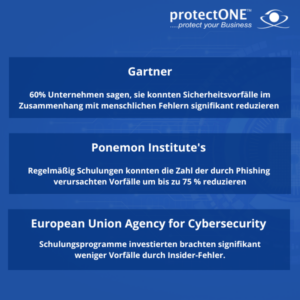
- Gartner 2021: Gartner found that by 2025, 60 % of organizations that implement security awareness training for their employees will significantly reduce security incidents related to human error. The study underlines the importance of a well-structured and regularly updated training program.
- Ponemon Institute's „State of Cybersecurity Report“: According to this study, the likelihood of security incidents was significantly reduced in companies that had implemented comprehensive security awareness programs. Companies that carried out regular training were able to reduce the number of incidents caused by phishing by up to 75 %.
- European Union Agency for Cybersecurity (ENISA) - Cybersecurity Culture and Behavioral Studies: ENISA published reports showing that organizations that invested in strengthening cybersecurity culture through training programs recorded significantly fewer incidents due to insider mistakes. It was emphasized that programs that are planned for the long term and adapted to the specific needs of the company have the greatest success.
Why is security awareness important?
The most effective technical safety device can be circumvented by human error. A single rash act, The opening of an infected e-mail attachment can have far-reaching consequences for a company's entire IT infrastructure. A prominent example is the case of the Fürstenfeldbruck Hospital, which was paralyzed in 2018 by a Trojan that spread via a E-mail attachment and infected almost all of the hospital's computers. Such incidents highlight the need to regularly inform employees about current threats and appropriate response strategies.
Block "4319" not found
Components of an effective security awareness program
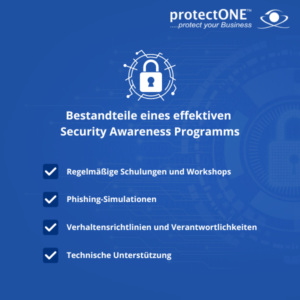 A comprehensive security awareness program should contain several core components:
- Regular training courses and workshops: Modern online training modules offer flexible learning opportunities that can be easily integrated into everyday working life. These modules cover topics such as phishing, social engineering, secure use of mobile devices and basic data security.
- Phishing simulations: These simulations help to test the knowledge learned and uncover weaknesses in employees' security awareness. Unannounced tests can show how well the training content is applied in practice. Software such as that from Sophos can take care of such things.
- Behavioral guidelines and responsibilities: Clearly defined guidelines and responsibilities ensure that every employee knows what to do in the event of a security threat. This includes the secure handling of emails, the use of strong passwords and the protection of physical devices in the workplace.
- Technical support: In addition to organizational measures, technical security precautions should also be taken. These include the use of firewalls, regular backups and the implementation of multi-factor authentication.
Practical implementation in the company
The implementation of a security awareness program requires careful Planning and continuous adaptation. Start by taking stock of the current security situation and identify your organization's specific needs and vulnerabilities. Use proven frameworks and tools to develop an effective training program that addresses the Tailored to the needs of your employees is.
Example of a training module
A typical training module could look like this:
- Introduction to IT security risks: Explain to employees why IT security is important and what the risks are.
- Phishing and social engineering: Give examples of phishing attacks and show how to recognize and avoid them.
- Secure handling of passwords: Teach the importance of strong passwords and how to create and manage them.
- Data security in the home office: Raise awareness of the particular risks of working from home and give practical tips on how to secure home networks.
Further aspects of security awareness
There are additional aspects that need to be considered when implementing a successful security awareness program:
- Management commitment and support: A successful program needs the full support of management to emphasize the importance of the issue and establish a culture of safety.
- Continuous further development and adaptation: As the threat landscape is constantly changing, the training content must also be updated regularly.
- Integration into the corporate culture: Safety awareness should not only be present in special training courses, but also in everyday working life.
- Measuring and evaluating effectiveness: Regular evaluations and analyses help to measure the effectiveness of the program and make improvements.
- Involvement of all employees: Every employee should be included in the program, regardless of their position in the company.
- Use of modern technologies and methods: Interactive e-learning modules and gamification approaches can make learning more engaging and effective.
Conclusion
A holistic security awareness program is essential to protect your company from the growing threats of cybercrime to protect it. It requires commitment at all levels, continuous adaptation and innovative methods to be effective. By combining training, simulations, management support and the involvement of all employees, you can create a strong Safety culture that protects your company in the long term.
Are you ready to take the next step and strengthen your cybersecurity? Take action now!
Block "4319" not found
