
General
AI in cybersecurity: friend or foe?

Aug
AI in cybersecurity: friend or foe?
In today's digitalized world, cyber security plays a central role. The Artificial intelligence (AI) offers immense potential here, but also significant challenges. Is AI a reliable partner or a dangerous enemy in cyber security? In this article, we want to shed light on the many facets of AI in IT security.
- Advantages of AI in cyber security
- Challenges and risks
- Practical examples and recommendations
- Conclusion on AI in cybersecurity
Advantages of AI in cyber security
Automated threat detection

AI systems can Large amounts of data in real time and identify unusual patterns. In this way, they quickly find indications of potential threats. Machine learning (ML) makes it possible to learn from previous attacks and proactively identify future threats. For example Anomalies in network traffic detected immediately and appropriate countermeasures are initiated.
This ability to detect threats automatically and in near real time is a key advantage of AI in cyber security. Traditional methods, which are often based on signature-based approaches, are not able to detect the Speed and complexity of modern cyber attacks to overcome. However, AI can recognize patterns and continuously evolve to identify new, previously unknown threats.
Enormous increase in efficiency for large and small companies
By automating security processes, companies can use their resources more efficiently. AI-supported systems take over repetitive tasks such as the Monitoring of networks and end devices, which relieves human security analysts and allows them to focus on more complex threats. This leads to a faster and more accurate response to security incidents.
Another advantage of automation through AI is the reduction of human error. Security processes that are carried out manually are prone to errors, whether due to carelessness or a lack of knowledge. AI-based systems can eliminate these Significantly reduce error rate, by working precisely and consistently.
This is important in large companies with extensive IT infrastructures, for example, where manual management of all security aspects is almost impossible. But also Small companies benefit enormously. Due to their size, they do not have the capacity for security analysts or 24/7 monitoring. AI closes this gap.
Proactive security measures
AI can anticipate threats and take preventive measures. By analyzing behavioral patterns and historical data, AI can identify and close security gaps at an early stage. This is particularly important in order to Preventing zero-day exploits, that target previously unknown vulnerabilities.
One example of this is predictive analysis. AI uses models to predict potential attack vectors and implement appropriate protective measures before an attack can even take place. These Proactive approach is a paradigm shift in cyber security: moving away from reactive measures towards preventive strategies.
Block "4319" not found
Challenges and risks
Abuse by cyber criminals
 AI can also be used by cyber criminals to optimize their attacks. For example AI-driven malware and phishing attacks be more effective and harder to detect. AI can also be used to automatically identify and exploit security vulnerabilities in systems. For example, AI-supported phishing emails that look deceptively genuine enable attackers to steal personal data.
One worrying scenario is the use of Deep learning by cyber criminals to develop polymorphic malware. This type of malware constantly changes its code to evade detection by traditional security solutions. AI can also be used to orchestrate complex social engineering attacks by creating personalized attack vectors aimed at the specific vulnerabilities and behavioral patterns of targeted individuals.
Complexity and misinterpretations
The implementation of AI systems requires extensive expertise. Misconfigurations or faulty algorithms can lead to false alarms or unrecognized threats. There is also a risk that AI models could be manipulated to deliver false results and undermine security measures. This poses a significant risk to the integrity of the security infrastructure.
Another problem is the so-called Black box nature of many AI models. These systems make decisions based on complex algorithms that are often not fully comprehensible. This can lead to security officers not trusting the AI's decisions or not interpreting them correctly. This in turn can impair the effectiveness of security measures.
Dependency and security gaps
Over-reliance on AI-based security solutions can create new vulnerabilities. Companies must ensure that their AI systems are regularly reviewed and updated. Solutions from major manufacturers such as Sophos do this automatically. In addition, the human expertise always an integral part of the security strategy to recognize and correct potential errors or manipulations of the AI. There must therefore be at least one employee who keeps an eye on the dashboard of the respective solution.
It is important that companies develop a balanced security strategy that relies on both automated AI solutions and the expertise of human employees. The combination of both approaches can help maximize the security of the IT infrastructure while minimizing the risks that could arise from over-reliance on a single technology.
Practical examples and recommendations
Use of AI in practice
Companies such as Microsoft and IBM are already successfully using AI technologies to protect their IT infrastructures. These companies use AI-supported systems to Real-time analysis of network information and to identify threats. By combining AI and human expertise, they can develop effective and comprehensive security strategies.
One concrete example is the use of AI in the detection and defense of DDoS attacks (Distributed Denial of Service). These attacks, which aim to paralyze networks through a flood of requests, can detected and averted in real time by AI-controlled systems, by distinguishing malicious traffic from legitimate requests and initiating appropriate countermeasures.
Recommendations for companies
To make the most of the benefits of AI in cyber security, you should take the following measures:
- Training and further education: Train your employees in the use of AI-supported security solutions to fully exploit their potential and minimize risks. Regular training and workshops help to keep employees' knowledge up to date and improve their ability to interact with and monitor AI systems.
- Regular review: AI systems must be continuously monitored and updated to detect and combat new threats. This includes regular security checks and audits to ensure that the AI models are functioning correctly and have not been tampered with.
- Include human expertise: Despite the benefits of AI, human expertise is essential. Security analysts should work closely with AI systems to achieve optimal results. The combination of human judgment and the analytical capability of AI can help create a comprehensive security network that is both flexible and robust. Companies such as Sophos that offer such software usually have their own experts. They at least take care of the software. However, you should take care of the network and infrastructure yourself.
Another important aspect is the development of Guidelines and best practices for the use of AI in cyber security. These should clearly define how AI systems are implemented, monitored and maintained to ensure maximum effectiveness while minimizing risks.
Conclusion on AI in cybersecurity
Artificial intelligence is a powerful tool in cyber security that brings both significant benefits and potential risks. Through the Automation of security processes and the proactive detection of threats, AI can help companies defend themselves against modern cyber threats. At the same time, it is important to recognize the potential risks and take appropriate measures to minimize them. A balanced Combination of AI and human expertise offers the best protection for a company's IT infrastructure.
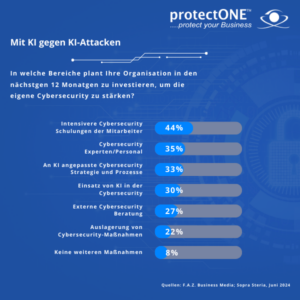
The future of cyber security will depend heavily on the further development and integration of AI technologies. Companies need to be prepared to invest in these technologies and Adapt security strategies accordingly, to counter the constantly growing threats from cyberspace. In doing so, they should always maintain a balance between automation and human control to create a robust and flexible security network that can meet the challenges of the future.
One thing is clear in any case: your potential attackers are already using AI. You should definitely keep pace with this development.
Block "4319" not found
